
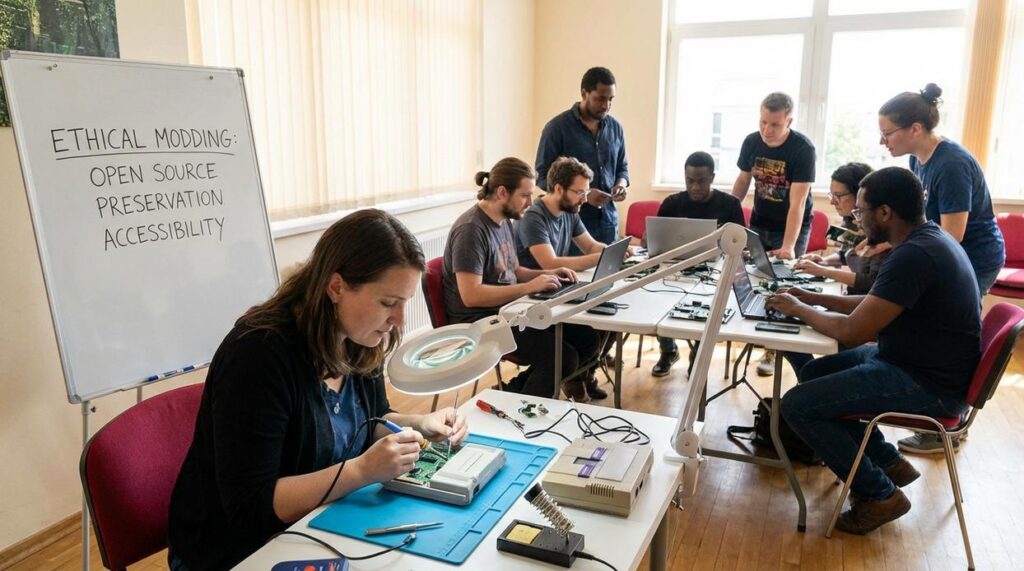
Modding has long been a celebrated pillar of PC gaming—fueling creativity, extending game lifespans, and building passionate communities. Yet behind the innovation lies a complex ethical gray area many players and creators rarely stop to examine. From disrupting multiplayer balance to crossing intellectual property boundaries, even well‑intentioned mods can raise serious concerns. Within the community, debates around fairness, ownership, and developer respect are ongoing and often misunderstood. This guide offers modding ethics explained through a clear, practical framework—helping you understand where the lines are drawn and how to ensure your mods strengthen the gaming ecosystem rather than unintentionally harm it.
The Core Conflict: Creator’s Vision vs. Player Freedom
The first time I installed a total overhaul mod for a fantasy RPG, I remember thinking: Is this still the same game? The story beats were familiar, but the combat, visuals, even the tone had shifted. It felt like remixing a director’s cut without asking the director.
At its heart, this debate asks a simple question: Is a game a finished piece of art, or a sandbox for player expression? A fixed artistic work means the developer’s intent is final. A platform for expression treats the game like LEGO—meant to be rebuilt.
Mods fall on a spectrum:
- Quality-of-life tweaks: UI improvements, bug fixes, accessibility add-ons.
- Balance changes: Adjusting difficulty or character stats.
- Total conversion mods: Complete identity shifts—new worlds, mechanics, narratives.
Some argue any alteration disrespects creative intent. That’s fair. Developers like Riot Games and Bungie restrict mods in live-service titles to protect competitive balance and security (see Riot’s Terms of Service; Bungie’s Community Guidelines). Others, like Bethesda, provide official tools, practically inviting experimentation.
The unwritten rule? Start with the official policy. Respect the ecosystem. That’s where modding ethics explained truly begins.
Before diving deeper, review this beginners guide to game modding tools risks and rewards.
Pro tip: If a mod changes multiplayer fairness, think twice (no one likes a rigged match).
Fair Play: The Bright Red Line of Multiplayer Modding
Let’s draw the line clearly: any mod that gives a competitive advantage in multiplayer is unethical. No caveats. No “but everyone’s doing it.” If it alters the outcome of a match in your favor, it crosses the boundary.
This is where modding ethics explained becomes simple. In multiplayer spaces, fairness is the foundation. If one player secretly changes the rules, the entire match stops being a contest of skill and becomes a contest of exploits.
Defining Unfair Advantage
An unfair advantage is any modification that improves performance beyond intended game mechanics. Common examples include:
- Wallhacks – letting players see through walls.
- Aimbots – automatically locking onto opponents.
- Hitbox modifiers – enlarging enemy targets.
- Automation macros – scripting complex moves with one key.
- Visual removals – deleting foliage or shadows for clearer sightlines.
Some argue that small tweaks—like removing grass for visibility—aren’t “real cheating.” But if it improves awareness beyond what others see, it’s still altering competitive balance (yes, even if it feels minor).
The Cosmetic Gray Area
Purely cosmetic mods—custom skins or UI recolors—don’t boost performance. However, they can bypass monetization systems. While not competitive cheating, they raise ethical questions about supporting developers. It’s less about fairness, more about sustainability.
Impact on Community Health
Cheating mods erode trust. Once players suspect foul play, every loss feels rigged. Communities shrink. Matchmaking suffers. Games die (and we’ve seen it happen before).
Ethical modding protects the ecosystem. Fair play isn’t restrictive—it’s what keeps multiplayer alive.
Respecting Ownership: Copyright, Assets, and Monetization
Let’s start with Intellectual Property 101. Game assets—models, textures, sounds, dialogue, and code—are copyrighted material. Copyright means the creator has exclusive legal rights to reproduce and distribute that work (U.S. Copyright Office, 17 U.S.C. §106). Using those assets without permission isn’t “borrowing.” It’s infringement. Full stop.
Now, about the so-called “porting” scene. Ripping assets from one commercial game and dropping them into another might look impressive on YouTube, but it’s ethically shaky and legally indefensible. I don’t care how polished it looks—if you didn’t create it or license it, it’s not yours. This is where modding ethics explained in the section really matters.
Monetization is trickier. Selling a mod directly almost always violates a game’s EULA (End User License Agreement), which typically prohibits commercial exploitation. Some argue, “But I put in the work.” True—but you’re still building on someone else’s IP. A better route?
- Optional donations via platforms like Patreon or Ko-fi
- Clear disclaimers that supporters fund your time, not exclusive access
- Transparent communication about what’s free
The ethical high ground is simple:
- Create original assets
- Use open-source or royalty-free libraries
It may take longer (yes, Blender tutorials at 2 a.m.), but integrity beats shortcuts every time.
Community and Content: The Modder’s Social Responsibility
First and foremost, clear content warnings aren’t optional—they’re basic respect. If your mod includes NSFW material, extreme violence, or other sensitive themes, label it plainly. Content warnings help players make informed choices (no one wants a surprise that feels like a jump scare in real life). In my opinion, skipping tags for the sake of downloads is careless. Transparency builds trust.
At the same time, altering a game’s story is creative expression—but it’s also delicate. When you rewrite a beloved character or twist a canon ending, you’re stepping into shared cultural space. Some argue “it’s just a mod.” Maybe. Still, preserving narrative integrity matters because stories shape player experience. Respect for source material is part of modding ethics explained in the section.
Finally, safe distribution is non‑negotiable. Upload through reputable platforms like Nexus Mods and scan files for malware. Players should install with excitement—not anxiety.
Building a Better Gaming World, One Mod at a Time
You came here looking for clarity around modding ethics explained, and now you have it: respect the developer, never cheat in multiplayer, honor copyright, and stay accountable to the community. The biggest pain point in modding isn’t creativity — it’s ambiguity. Without a shared code, lines get blurred and communities fracture.
The solution is simple but powerful: choose a conscious, community-driven standard every time you create or install a mod.
If you care about the future of gaming, apply these principles in your own projects and actively champion them in forums and servers. Responsible modding today keeps the gaming world thriving tomorrow.

 Lorven Zyphandell has opinions about platform play strategies. Informed ones, backed by real experience — but opinions nonetheless, and they doesn't try to disguise them as neutral observation. They thinks a lot of what gets written about Platform Play Strategies, Insider Tips, Gamer Setup Optimization Tips is either too cautious to be useful or too confident to be credible, and they's work tends to sit deliberately in the space between those two failure modes.
Reading Lorven's pieces, you get the sense of someone who has thought about this stuff seriously and arrived at actual conclusions — not just collected a range of perspectives and declined to pick one. That can be uncomfortable when they lands on something you disagree with. It's also why the writing is worth engaging with. Lorven isn't interested in telling people what they want to hear. They is interested in telling them what they actually thinks, with enough reasoning behind it that you can push back if you want to. That kind of intellectual honesty is rarer than it should be.
What Lorven is best at is the moment when a familiar topic reveals something unexpected — when the conventional wisdom turns out to be slightly off, or when a small shift in framing changes everything. They finds those moments consistently, which is why they's work tends to generate real discussion rather than just passive agreement.
Lorven Zyphandell has opinions about platform play strategies. Informed ones, backed by real experience — but opinions nonetheless, and they doesn't try to disguise them as neutral observation. They thinks a lot of what gets written about Platform Play Strategies, Insider Tips, Gamer Setup Optimization Tips is either too cautious to be useful or too confident to be credible, and they's work tends to sit deliberately in the space between those two failure modes.
Reading Lorven's pieces, you get the sense of someone who has thought about this stuff seriously and arrived at actual conclusions — not just collected a range of perspectives and declined to pick one. That can be uncomfortable when they lands on something you disagree with. It's also why the writing is worth engaging with. Lorven isn't interested in telling people what they want to hear. They is interested in telling them what they actually thinks, with enough reasoning behind it that you can push back if you want to. That kind of intellectual honesty is rarer than it should be.
What Lorven is best at is the moment when a familiar topic reveals something unexpected — when the conventional wisdom turns out to be slightly off, or when a small shift in framing changes everything. They finds those moments consistently, which is why they's work tends to generate real discussion rather than just passive agreement.